The best marketing teams have both a Fractional CMO and an agency and/or an in-house marketing team.
Why? They solve entirely different problems, and the brands seeing the strongest growth right now aren’t choosing between the two; they’re layering them.
An agency is built to execute. A fractional CMO is built to lead. One without the other leaves gaps. Together, they create a marketing function that actually scales.
If you’re a founder or CEO trying to figure out where a fractional CMO fits into a team that already includes an agency, an in-house marketer, or both, this is the framework for thinking through it.
What a Marketing Agency Actually Does Well
Agencies are execution engines. The good ones are really good at it. They bring channel-specific expertise, creative production capacity, and the ability to move fast across paid media, email, SEO, social, and content.
Where agencies shine is in the doing: launching campaigns, optimizing ad spend, building email flows, producing creative assets, managing platforms. They have teams, tools, and established processes to deliver volume and consistency.
What agencies are not built to do is set the strategic direction for your brand. They can optimize what’s in front of them, but they’re working within the scope you give them. If nobody is defining that scope with precision — if nobody is connecting what the agency is doing to your overall business goals, your margin targets, your customer lifetime value — then even great execution drifts.
This isn’t a criticism of agencies. It’s a structural reality. Agencies are hired to execute a brief, not to write the brief.
What a Fractional CMO Actually Does
A fractional CMO operates at the strategic layer. They’re not running your Facebook ads or writing your email sequences — they’re the person asking why those ads are targeting that audience and whether those email sequences are actually moving the needle on retention.
Think of it this way: the agency is driving the car. The fractional CMO is deciding where the car sho:uld go.
In practice, a fractional CMO:
- Sets the overall marketing strategy and KPIs
- Audits what’s working and what isn’t across every channel
- Aligns marketing efforts with business-level goals like profitability, customer acquisition cost, and lifetime value
- Manages the relationship with your agency to ensure execution matches strategy
- Identifies the gaps nobody else is looking at — because nobody else is responsible for the big picture.
They sit at the leadership table. They attend your executive meetings. They translate between the language of marketing metrics and the language of business outcomes.
That translation layer is what most scaling brands are missing.
The Real Problem: Nobody Ownsthe Business KPIs
Here’s a scenario that plays out constantly in scaling brands.
You have an agency running your ads. You might have an in-house marketer managing email or social. Maybe you’ve got a freelancer doing content. Each of these people is doing their job. The campaigns are going out. People are converting.
But who is zooming out and asking whether all of these pieces are actually aligned with where the business needs to go in twelve months?
Who is looking at the data across every channel and identifying where the real leverage is? Who is accountable for marketing as a growth function, not just a collection of tactics?
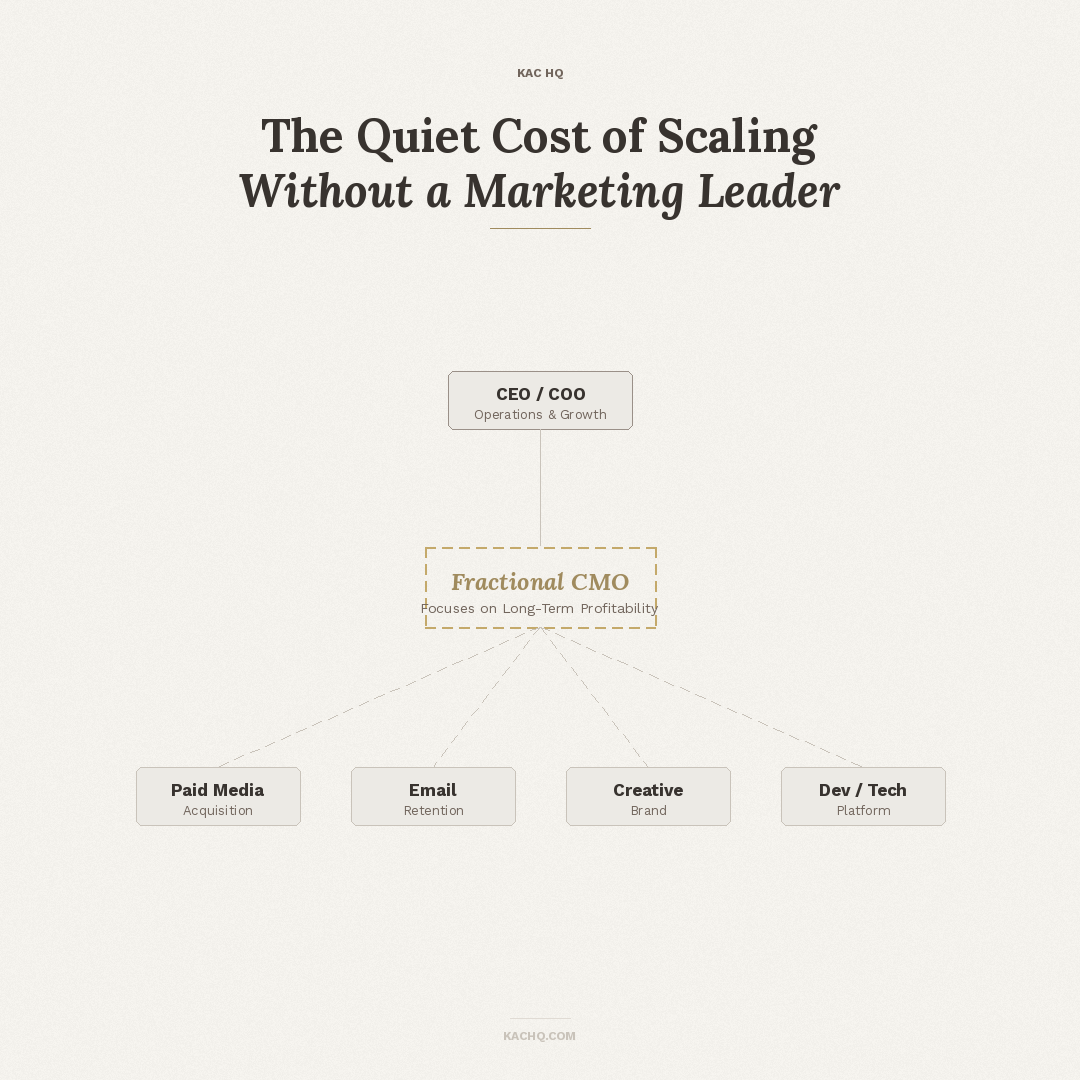
In too many cases, the answer is the CEO or COO — who is already stretched thin across a dozen other priorities. They end up doing marketing oversight with whatever time is left over, which usually means the strategic layer gets the least attention despite being the most impactful.
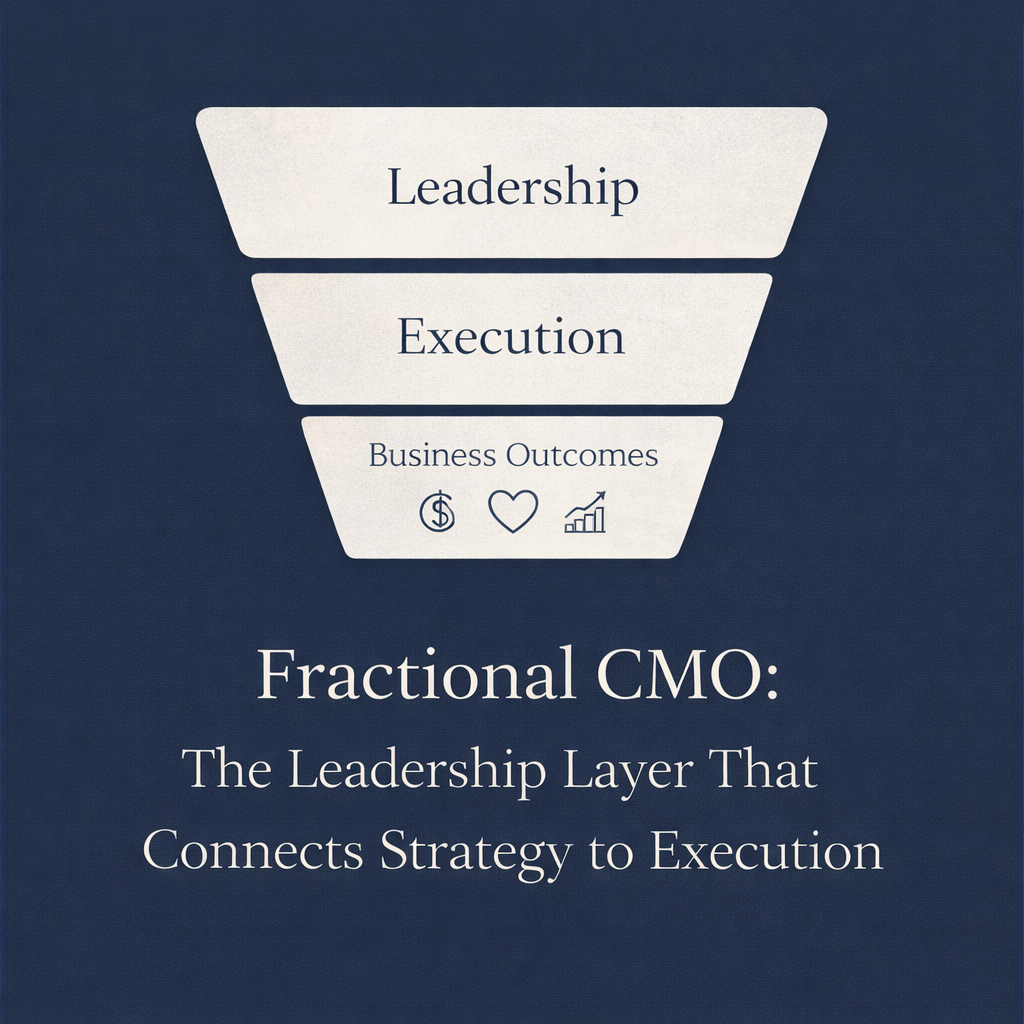
This is the gap a fractional CMO fills. Not by replacing your agency or your in-house team, but by providing the leadership layer that connects everything together.
You Don’t Have to Choose — Here’s How They Layer Together
The most effective marketing structures we see in scaling brands look something like this:
The fractional CMO sets the strategy, defines KPIs, and holds everyone accountable to business outcomes.
The agency executes campaigns across their area of expertise — paid media, email, SEO, whatever the scope covers. The in-house team (if you have one) handles day-to-day operations, brand voice, and internal coordination.
The fractional CMO becomes the connective tissue.
They give the agency a sharper brief. They help the in-house team prioritize. They report to leadership in terms of revenue impact, not vanity metrics.
Whether you currently have an agency and no in-house team, an in-house team and no agency, or both, there is still a place for a fractional CMO. The question isn’t which one you need. It’s which layer is missing?
When a Full-Time CMO Makes More Sense
There comes a point where a full-time CMO is the right call.
Generally, that’s when the complexity of your marketing operation demands 40+ hours per week of dedicated strategic leadership — multiple product lines, multiple markets, a large in-house team that needs daily management.
But here’s a scenario most people don’t talk about: the promote-from-within play.
Many scaling brands have a junior or mid-level marketer who has been with the company since the early days.
This person has something that can’t be hired for — deep institutional knowledge, understanding of the brand voice, relationships across the organization, and a vested interest in the company’s success.
Promoting that person into a full-time CMO role is smart. But there’s often a gap between where they are today and the strategic skill set a CMO needs.
They may be exceptional at execution but haven’t yet had the experience of building a full marketing strategy from the ground up, managing agency relationships at a senior level, or translating marketing metrics into board-level conversations.
This is where a fractional CMO becomes something more than a stopgap — it becomes a training ground.
The fractional CMO leads the strategy, and your internal rising star works alongside them, absorbing the frameworks, the decision-making process, and the executive communication skills they’ll need. Over six to twelve months, the fractional CMO works themselves out of a job — because your internal leader is ready to take the reins.
That’s not just cost-effective. It’s the kind of leadership development that builds a stronger company long-term.
How to Know What You Need Right Now
If your marketing feels busy but disconnected — if the campaigns are running but growth has plateaued — the issue is almost never that your agency isn’t working hard enough. It’s that nobody is steering the ship.
Ask yourself these questions:
- Does someone on your team own the overall marketing strategy and report on it at the executive level?
- Can you clearly articulate how your marketing spend connects to your profitability goals?
- When your agency asks for direction, does someone have a clear, data-informed answer?
- Is there a person responsible for identifying what’s not working and making the call to change course?
If the answer to most of those is no, you don’t need more execution. You need leadership.
A fractional CMO gives you that leadership without the $250K+ commitment of a full-time executive hire.
And if you already have agency partners doing strong work, a fractional CMO doesn’t disrupt that — it makes them more effective by giving them better direction.
Frequently Asked Questions
Can a fractional CMO and agency work together? Yes, and in most cases they should. The fractional CMO provides strategic direction and accountability while the agency handles execution. This combination ensures that the work being done is aligned with business goals, not just channel-level metrics.
How much does a fractional CMO cost compared to an agency? Fractional CMO engagements typically range from $5,000 to $15,000 per month, depending on scope and experience level.
Agencies vary widely from $2,500 to $12,000+ per month. Many brands invest in both, and the fractional CMO often improves the ROI of agency spend by ensuring strategic alignment.
What’s the difference between a fractional CMO and a marketing consultant? A consultant diagnoses problems and makes recommendations. A fractional CMO embeds in your team, owns the strategy, manages execution partners, and is accountable for results. They’re a leader, not an advisor.
When should I hire a full-time CMO instead of a fractional one? When your marketing operation is complex enough to require 40+ hours per week of dedicated strategic leadership — typically at $30M+ in revenue with multiple product lines, markets, or a large internal team.
Below that threshold, a fractional CMO often delivers the same strategic impact at a fraction of the cost.
Can a fractional CMO help me develop an internal marketing leader? Absolutely. One of the most valuable outcomes of a fractional CMO engagement is mentoring an internal team member into a full-time leadership role. The fractional CMO provides the strategic framework and executive experience while your internal hire learns on the job.
The Bottom Line
The brands that scale sustainably aren’t the ones with the biggest ad budgets or the most agencies on retainer. They’re the ones with someone at the top of the marketing function asking the right questions, connecting the dots, and making sure every dollar spent is moving the business forward.
If that person doesn’t exist in your organization today, you’re not alone — and you don’t have to make a six-figure hire to fix it.
A fractional CMO gives you the strategic leadership your marketing needs to actually drive growth, not just stay busy. And if you already have a great agency, great team, or both — a fractional CMO doesn’t replace them. It makes everything they’re already doing work harder.
Ready to find out what’s missing in your marketing? [We’ll show you exactly where the gaps are — and how to close them. Learn more about our fractional CMO services →