Your flows are running. Your ads are profitable. Your team is executing. And your margins are still eroding—quietly, consistently, in places no one is watching closely enough to catch. This is the cost of scaling without a Fractional CMO.
You won’t experience a catastrophic failure overnight, just the slow, compounding drag of a business where nobody owns the strategic layer—where no one is responsible for asking whether the systems that are working are actually working toward the right KPIs.
If you’re a founder or operator running a scaling ecommerce brand and you’ve started to wonder whether it’s time to hire a fractional CMO, this piece is for you. Not because your team is failing. Because your team deserves someone whose entire job is to make sure their work compounds.
The Strategy Gap Nobody Talks About
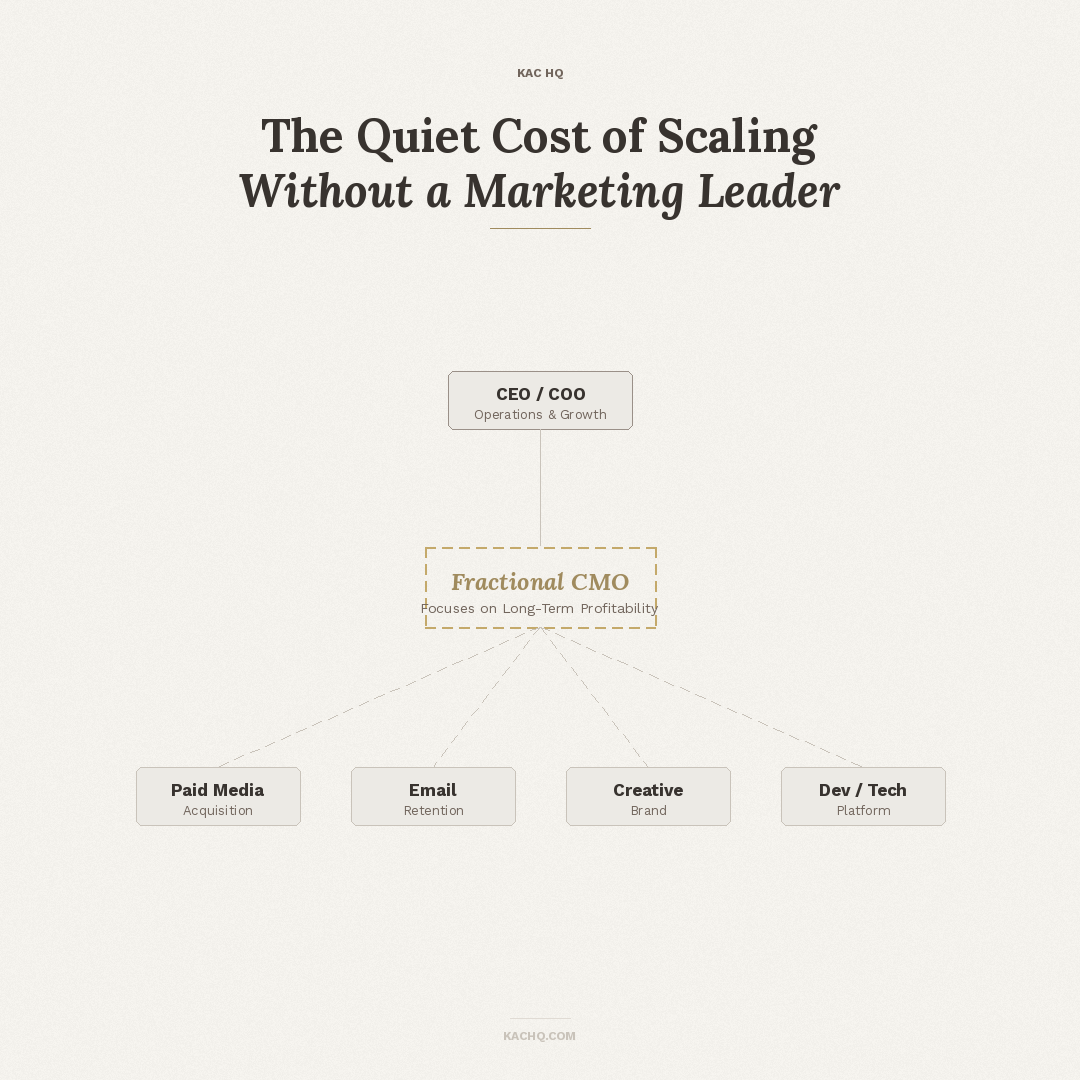
Scaling brands are good at hiring specialists. A paid media buyer for acquisition. An email marketer for retention. A designer for creative. A developer for the site. Each person owns a channel, executes within it, and reports on the numbers that live inside their lane.
What’s missing is the person whose job it is to look across all of those lanes and answer one question: are these efforts aligned with our short and long-term KPIs? Because most people in the weeds are working toward daily, weekly, or quarterly goals within their control — but who is looking at the long-term profitability KPIs?
This isn’t a tactics problem, it’s a marketing leadership problem, and it’s the one most brands at the $2M–$10M revenue range refuse to address—not because they don’t see it, but because the CEO or COO has been absorbing the role by default.
They sit in on campaign reviews, they approve creative, they glance at dashboards between investor calls and operations meetings. They care deeply about the marketing function. But caring about it and owning it are two fundamentally different things. And the gap between the two is where profit margins erode.
Marketing Strategy vs. Marketing Tactics: Why the Distinction Matters
Every scaling brand has tactics, and every business has a growth strategy. Fewer have someone accountable for making sure the tactics serve the overarching business strategy.
Tactics answer the question: what are we doing?
Strategy answers: why this, now, and at what cost to everything else long-term?
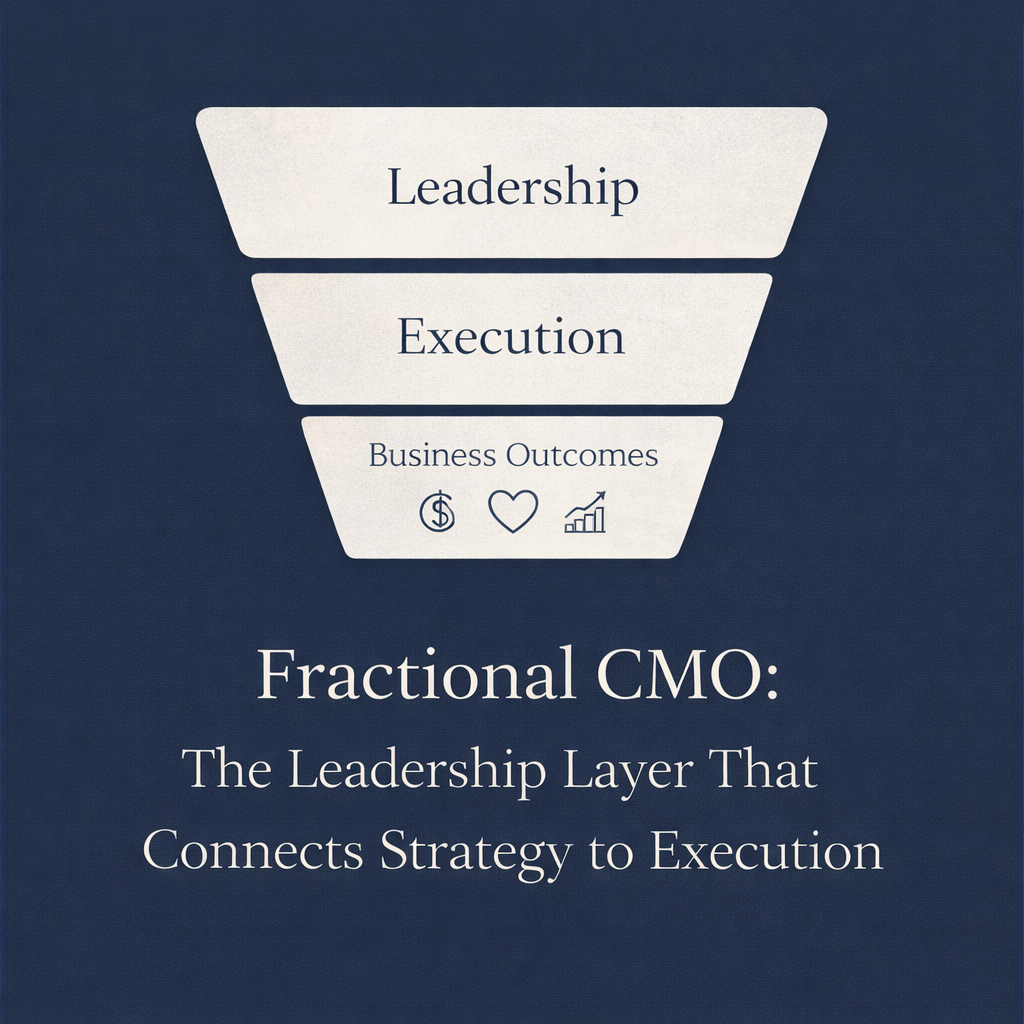
When there’s no ecommerce marketing leadership sitting above the execution layer, tactics begin to operate autonomously.
- Paid media optimizes for ROAS without accounting for what happens post-purchase.
- Email flows run on autopilot because they’re technically “converting”—even if the conversion rate is half of what it could be.
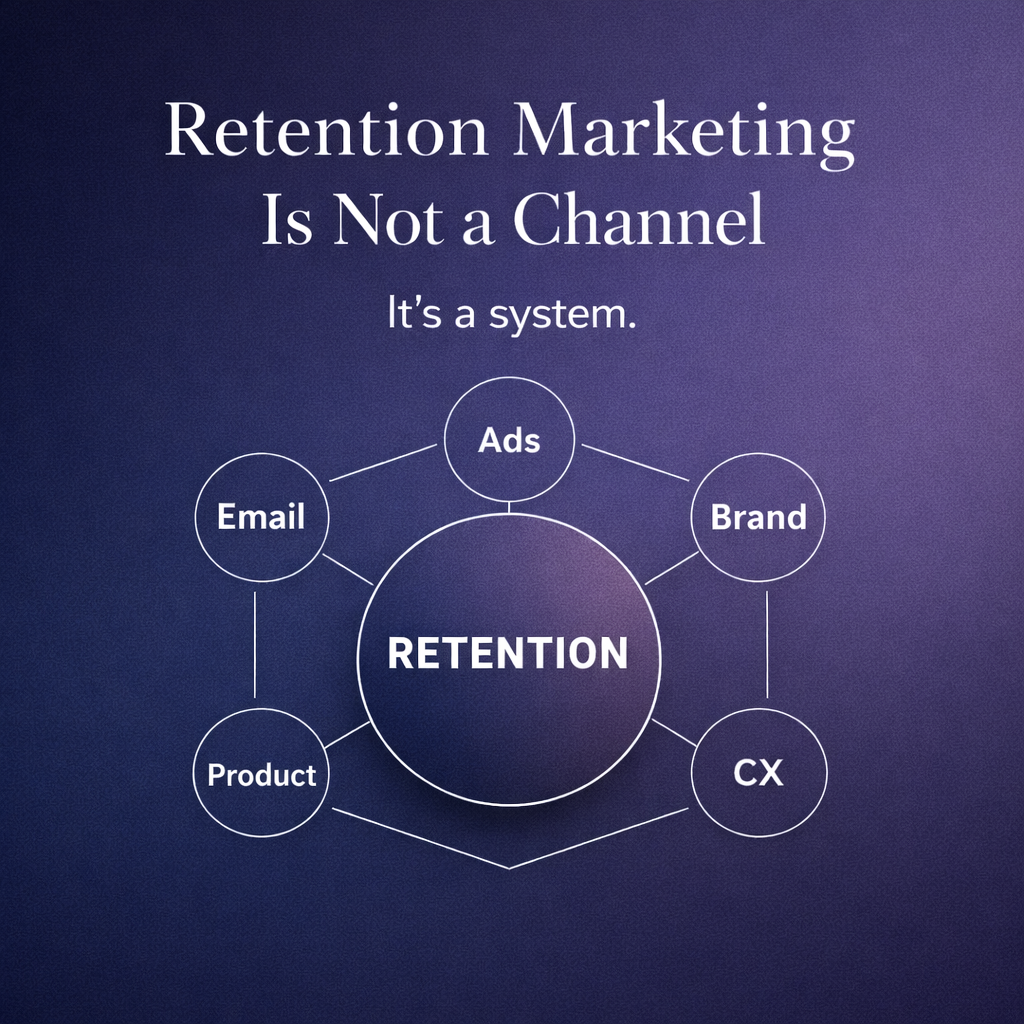
- Retention gets deprioritized because acquisition feels more urgent.
None of this looks like a crisis. It looks like a functioning marketing department. That’s what makes it so dangerous.
The numbers aren’t bad enough to trigger alarm bells, but they’re not good enough to support the growth trajectory the brand is banking on.
What Scaling Without a Fractional CMO Actually Costs
The cost isn’t a single line item. It’s distributed across the business in ways that are hard to isolate until someone finally sits down and connects the dots.
Unclosed Loops in the Customer Journey
Without a marketing leader auditing the full lifecycle, gaps develop between acquisition and retention that nobody is responsible for closing.
The onboarding sequence was built eighteen months ago and hasn’t been revisited. The post-purchase flow converts, but at a rate that’s leaving significant revenue on the table.
The win-back campaign exists, but nobody’s looked at the data to determine if the timing or segmentation still makes sense. These aren’t broken systems—they’re unattended ones.
KPIs That Don’t Connect
Each channel reports its own metrics.
Paid reports ROAS.
Email reports open rates and revenue attributed.
Organic reports traffic and conversions.
But nobody is responsible for asking whether these KPIs collectively are optimized toward overall growth and profitability, or if they are just incrementally improving within their own marketing silo.
A fractional CMO isn’t just setting KPIs. They’re building a measurement framework where every metric serves the same strategic business outcome: growth and profitability.
Opportunity Cost of CEO Attention
Every hour a founder spends reviewing campaign performance, approving creative direction, or troubleshooting a channel is an hour not spent on product development, partnerships, fundraising, or operations.
This isn’t a productivity problem. It’s a decision architecture failure.
The CEO is the most expensive person on the team—and in many scaling brands, they’re functioning as a part-time CMO without the bandwidth to do the job well.
Where Attention Goes, Money Flows
We recently began working with a brand that, by most visible metrics, had its marketing dialed in. Customer acquisition cost was optimized. They had automated flows handling onboarding, retention, and win-back. Paid media was profitable. The team was competent and executing consistently.
But their profit margins weren’t supporting the growth they needed—and they couldn’t figure out why.
The issue wasn’t capability. Every person on the team was skilled in their function. The issue was that nobody’s job was to sit above the execution layer and ask: are these systems actually performing at the level this brand needs to hit its year-over-year goals? Are these flows converting at the rate that supports profitability in a market that gets more competitive every quarter?
The answer, once someone finally looked, was no.
The automated onboarding and retention flows were “working”—in the sense that people were converting off of them. But the conversion rates were well below what was needed to offset rising acquisition costs and support sustainable growth. Nobody had revisited the flows with fresh eyes because they were technically functional. They were sending. People were buying. It just wasn’t enough.
Within weeks of stepping into the fractional CMO role, we identified the specific gaps, set overall KPIs tied to profitability rather than vanity metrics, and worked through the data to build a concrete plan for increasing margin through improved onboarding conversion and lifetime retention value.
The team didn’t need to be replaced. They needed direction. They needed someone whose sole focus was the strategic layer—someone who could look at the full picture and say this is where we’re leaving money, and this is exactly how we close the gap.
Where attention goes, energy flows.
Signs Your Brand Needs a Fractional CMO
Not every brand needs a full-time CMO. Most scaling brands don’t—yet. But there’s a specific inflection point where the absence of marketing leadership starts costing more than the investment of bringing one in.
Here’s what that inflection point typically looks like:
Your CEO or COO is still the de facto marketing decision-maker. They’re approving creative, reviewing dashboards, and weighing in on channel strategy—but it’s not their primary role, and it’s taking bandwidth from the work only they can do.
Your team is executing, but nobody is evaluating against the big picture of overall profitability. Campaigns are running, flows are sending, and reports are being generated—but nobody is connecting the dots between channels to determine whether the collective output is driving toward profitability.
Your retention metrics have been “fine” for too long. Fine is the most expensive word in business. If your onboarding, repeat purchase, and customer lifetime value metrics haven’t meaningfully improved in the last two quarters, someone needs to own that problem full-time.
You’re scaling revenue, but margins aren’t keeping pace. Top-line growth without corresponding margin improvement is a signal that your marketing system is optimized for volume, not value. A fractional CMO reorients the entire function around profitability.
You’ve outgrown your agency but aren’t ready for a full-time executive. Agencies execute. They don’t typically own a strategy at the level a scaling brand requires. But a full-time CMO at $200K–$350K might not make financial sense yet. A fractional CMO gives you executive-level marketing leadership at a fraction of the commitment.
What a Fractional CMO Actually Does
The value of a fractional CMO isn’t in doing the work your team already does. It’s in creating the conditions under which that work compounds over time.
A strong fractional CMO audits your current marketing ecosystem—not just channels, but the relationships between them.
They identify where the customer journey has gaps, where KPIs are disconnected from business outcomes, and where execution is happening in a vacuum.
They build the measurement framework that ties every channel’s performance back to profitability.
They set the strategic direction and hold the team accountable to outcomes that matter, not activity metrics that look good in a slide deck.
Most critically, they bring a data-driven lens to decisions that have been made on instinct or inertia.
Not because instinct is wrong, but because instinct without data is a gamble—and scaling brands can’t afford to gamble on the layer that determines whether their growth is sustainable.
The Most Expensive Hire Is the One You Keep Putting Off
Scaling brands don’t typically fail because of bad marketing. They plateau because no one is responsible for making sure good marketing stays aligned with where the business is going.
The cost of that gap isn’t dramatic.
It’s the 3% improvement in onboarding conversion that would have changed your quarter. It’s the retention strategy that’s been on autopilot for a year. It’s the CEO spending ten hours a week on marketing decisions instead of the work only they can do. It adds up—and by the time it shows up in the margins, the compounding effect means you’re already behind.
If any of this sounds familiar, the question isn’t whether you need marketing leadership. It’s how much longer you can afford to go without it.
KAC HQ provides fractional CMO services for brands ready to move from reactive execution to strategic, data-driven marketing leadership.